Supercapacitors in the smart metering
2025-11-30
Supercapacitors are increasingly becoming a core energy storage component in smart metering (including smart electric, water, and gas meters). They mainly act as backup power sources and peak power supplements, making up for the shortcomings of traditional lithium batteries in scenarios such as harsh environments and frequent peak power demands.
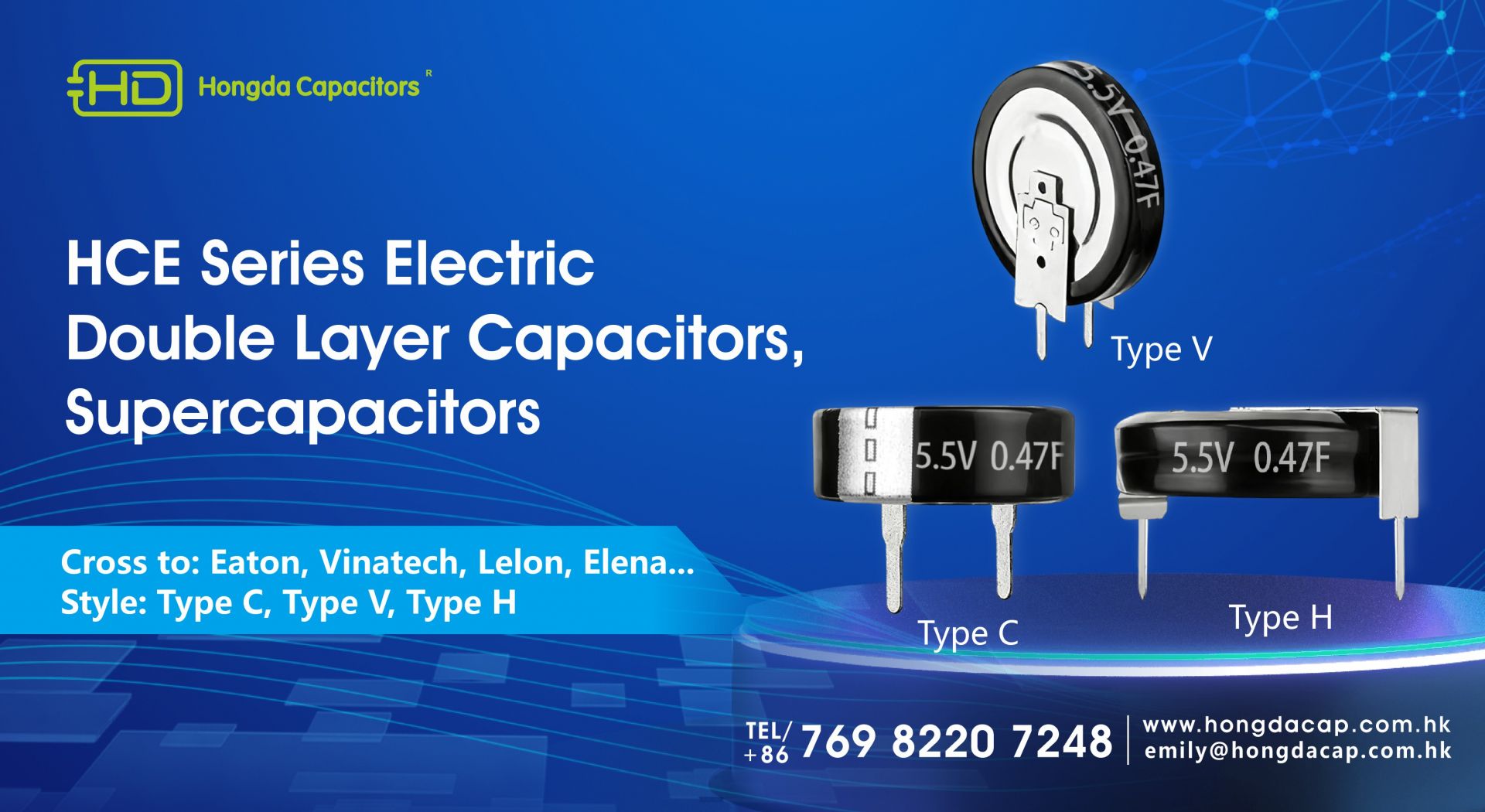
The following is a detailed analysis of their specific applications, core advantages, and existing challenges in smart metering:
Key Applications
Guaranteeing power-off data storage:
When the power grid is suddenly cut off, smart meters need to immediately save key data such as billing records and power consumption. Supercapacitors can switch to power supply within 0.1 seconds. They can maintain the operation of the meter's memory and clock circuit for several minutes, ensuring that data will not be lost due to sudden power failure. This avoids billing disputes caused by data loss which often occurs when traditional lithium batteries fail to respond in extreme conditions.
Supplying peak power for data transmission:
Smart meters usually rely on NB-IoT, LoRa, 4G and other wireless protocols to transmit data remotely. These communication modules will generate peak current demands of 0.2A - 0.5A during operation. Traditional lithium thionyl chloride batteries used in meters are difficult to provide such instantaneous large currents, and their voltage may drop by about 1V, leading to communication interruptions. Supercapacitors have extremely low equivalent series resistance. When supplying 0.5A current, the voltage drop is only about 50mV, which can stably provide peak power for communication modules. At this time, the battery only needs to supply a small average current of about 1mA to charge the supercapacitor.
Compensating for battery under-voltage to stabilize clock operation:
The clock chip of the smart meter needs continuous power supply to ensure accurate timing, which is the basis for correct billing. When the lithium battery used in the meter is under-voltage or fails, the supercapacitor can automatically take over the power supply task of the clock circuit, avoiding timing errors and subsequent billing mistakes.
Core Advantages
Ultra-long life supporting maintenance-free operation:
The number of charge-discharge cycles of supercapacitors can reach hundreds of thousands or even millions of times. If charged and discharged 20 times a day, they can be used continuously for up to 68 years, which is hundreds of times that of lithium batteries. This enables smart meters to achieve the commitment of ten-year maintenance-free, greatly reducing the cost of manual battery replacement for power supply companies.
Excellent temperature adaptability adapting to harsh environments:
Supercapacitors can work stably in the temperature range of -40°C to +85°C. Even at -40°C, they can still maintain more than 80% of their capacity, and at 85°C, they can retain 90% of their initial capacity. This solves the problem that traditional lithium batteries are prone to performance degradation, failure, or even leakage in extreme cold or hot outdoor environments.
High safety and environmental friendliness:
Unlike lithium batteries which have risks of leakage, overheating, and fire, supercapacitors adopt physical charge adsorption energy storage. They have no risk of thermal runaway and are more stable in use. Moreover, they do not contain toxic chemicals, which is in line with environmental protection requirements and reduces environmental pollution caused by battery disposal after the retirement of smart meters.
Simple charging and no memory effect:
The charging of supercapacitors is a physical process of electric double layer charging and discharging. It can be fully charged in tens of seconds to several minutes, and the requirements for the charging circuit are simple. Unlike rechargeable batteries, they have no memory effect and do not need special charging and discharging management to maintain capacity, simplifying the design of the meter's power management circuit.
Existing Challenges and Corresponding Solutions
Low energy density requiring hybrid configuration:
The energy density of supercapacitors is much lower than that of lithium batteries, so they cannot meet the long-term continuous power supply demand of smart meters alone. At present, the mainstream solution is to use a hybrid power supply mode of "battery + supercapacitor". The battery provides long-term low-power supply, while the supercapacitor responds to peak power and emergency backup needs. For example, the 4G smart power meter solution launched by Renesas uses a supercapacitor as a backup power source and cooperates with a voltage regulator to maximize the utilization of the supercapacitor's power.
Leakage current requiring low-power balancing design:
When supercapacitors are connected in parallel with batteries for a long time, leakage current and balancing current may consume the battery's power. To solve this problem, manufacturers such as CAP-XX have developed supercapacitors with ultra-low leakage current (about 1µA/F) and matching low-power balancing circuits. The total current consumption of the supercapacitor module is only about 1.7µA, which only consumes 0.1% of the power of a 15Ah battery a year, minimizing the impact on the battery's service life.
Low single-cell voltage needing series combination:
The voltage of a single supercapacitor cell is usually only a few volts, which cannot meet the working voltage requirements of smart meters. When multiple cells are connected in series to increase voltage, voltage imbalance between cells may occur. At present, supercapacitor modules for smart meters are usually equipped with built-in balancing circuits. For example, dual-cell modules used with 3.6V batteries can realize automatic voltage balancing through dedicated circuits, ensuring reliable operation of the module.
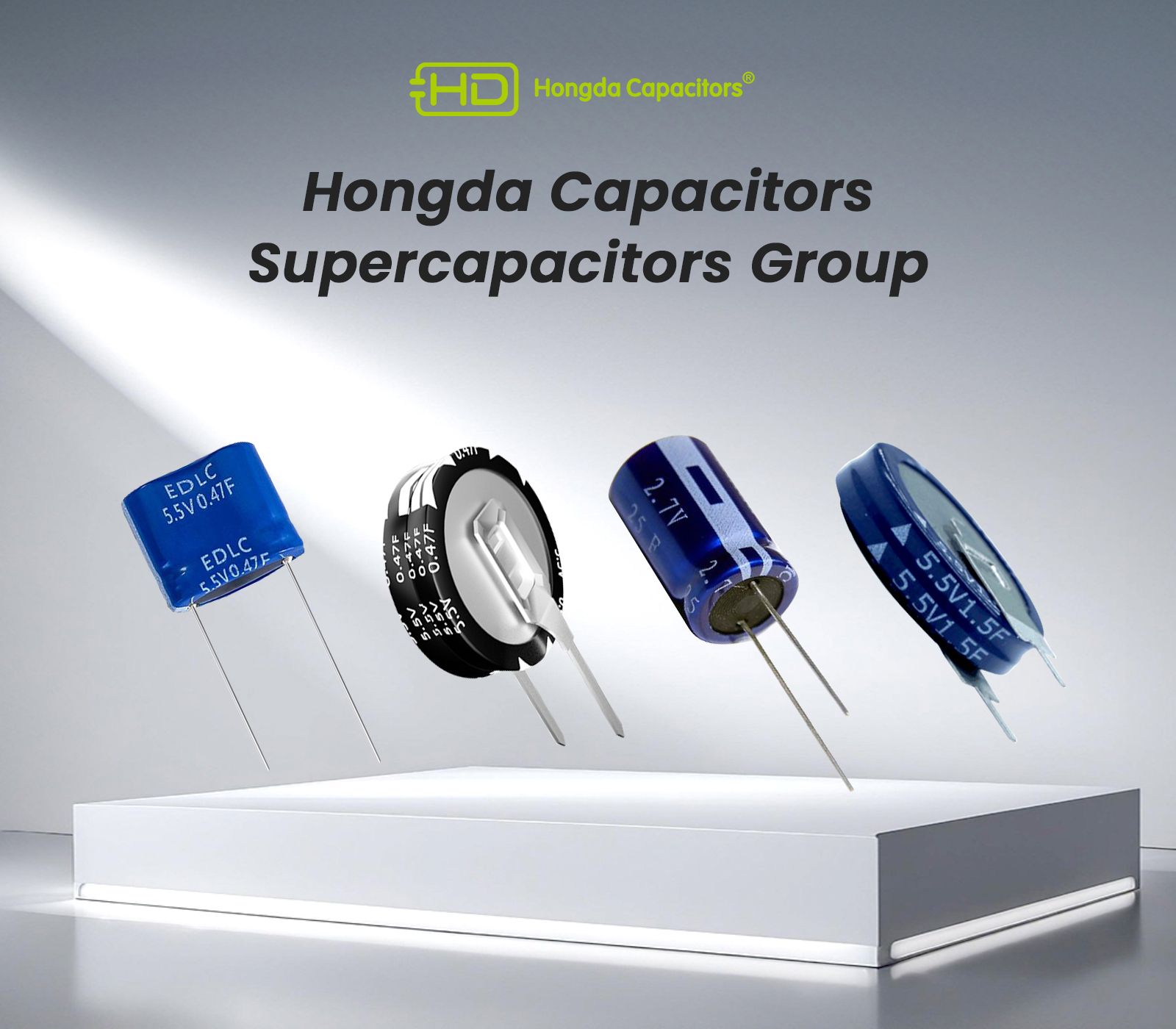
Hongda Capacitors offer Radial Type, Coil Type, EDLC type supercapacitors.
Most famous smart metering brands adapt our supercapacitors into their design and production.
For more inquiry, welcome to check with Emily Zhang via emily@hongdacap.com.hk
You can also find more of our product details at:
HCE Series Electric Double Layer Capacitors, Supercapacitors
https://www.hongdacapacitors.com/products/hce-series-electric-double-layer-capacitors-supercapacitors.html
HDS Series Winding Radial ultra capacitor
https://www.hongdacapacitors.com/products/hds-series-winding-radial-ultra-capacitor.html
HHP Series Radial Lead Type Supercapacitors
https://www.hongdacapacitors.com/products/hhp-series-radial-lead-type-supercapacitors.html
HHT Series Electric Double Layer Capacitors, Supercapacitors
https://www.hongdacapacitors.com/products/hht-series-electric-double-layer-capacitors--supercapacitors.html
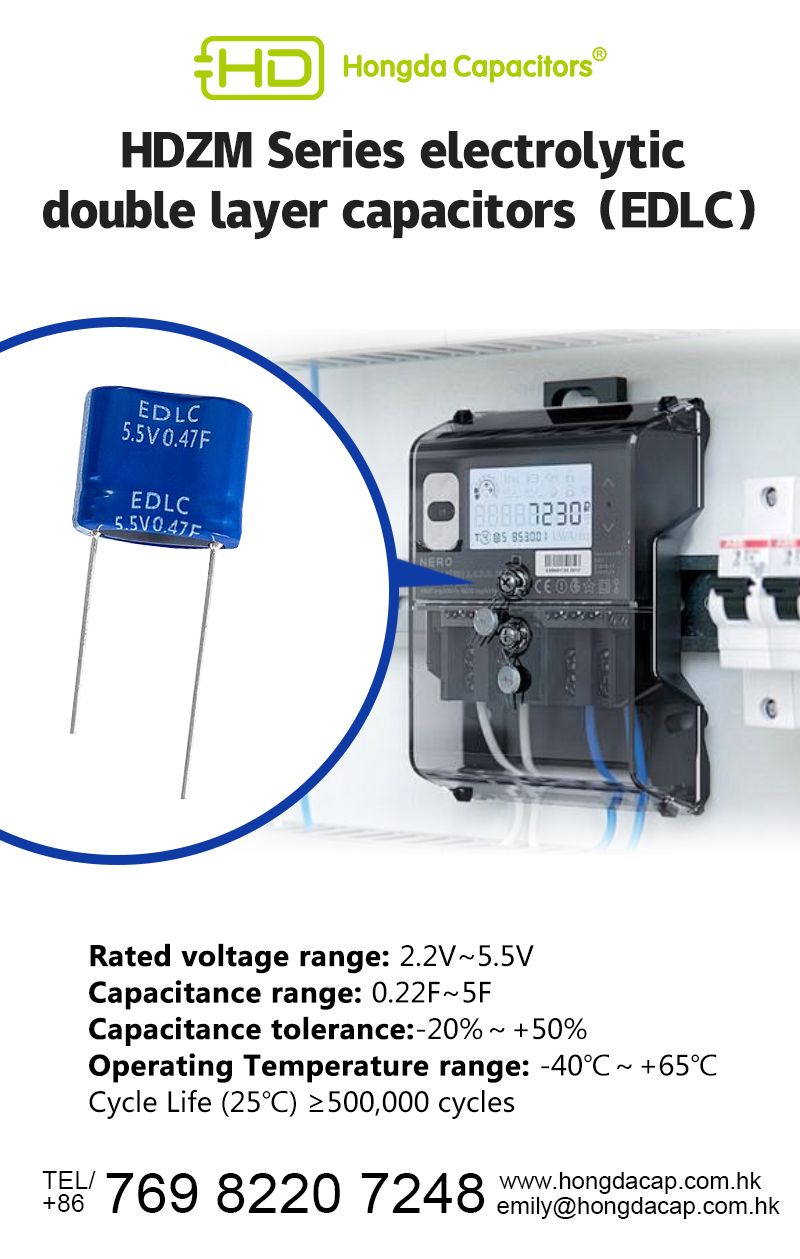
HDZM Series electrolytic double layer capacitors
https://www.hongdacapacitors.com/products/HDZM-Series-electrolytic-double-layer-capacitors.html
Hongda Capacitors also provide other capacitors, inductors and resistors.
We are open to discuss about your projects in details. Thank you.
Please find me here: emily@hongdacap.com.hk
MP/ Whatsapp/Wechat/ Teams :+86 13543726447


 English
 Chinese Simplified
 Russian
 Vietnamese
 Spanish
 Portuguese
 Arabic
 German
 Korean
 Polish
 Italian
 Turkish
 Belarusian
 Bulgarian
 Croatian
 Czech
Czech
 Danish
 Dutch
Dutch
 Estonian
 Filipino
 Finnish
 French
 Hungarian
 Indonesian
 Irish
Irish
 Japanese
 Lithuanian
 Norwegian
 Romanian
 Serbian
 Slovak
 Slovenian
 Swedish
 Thai
Thai


