Requirements and Challenges of Passive Electronic Components for Embodied Intelligent Robots
2026-02-01
Embodied intelligent robots, as "physical-world agents," perform complex tasks like perception, decision-making, and execution in dynamic, unstructured environments. Their core value lies in physical interaction with the environment via mechanical structures and electronic systems. Passive electronic components—including resistors, capacitors, inductors, filters, connectors, and antennas—serve as the foundation of these electronic systems, directly determining the robots' reliability, stability, environmental adaptability, and interaction precision. Below is a concise analysis of the core requirements and key challenges for passive components, tailored to application scenarios such as home service, industrial inspection, medical assistance, and outdoor mobility.
Core Requirements for Passive Electronic Components:
The "embodiment" (physical interaction) and "intelligence" (real-time data processing) of embodied robots impose stricter demands on passive components compared to consumer electronics. Key requirements focus on six dimensions: environmental adaptability, reliability, miniaturization & integration, low power consumption, anti-interference, and interaction compatibility.
1. Extreme Environmental Adaptability
Robots operate across diverse settings, requiring components to withstand complex environmental stresses:
Temperature & Humidity: Withstand -40°C to 85°C for outdoor/industrial use and resist high humidity/chemical disinfectants in medical environments. Components should use temperature-stable materials (e.g., NP0/C0G MLCCs, metal film resistors) and sealed packaging (IP65+).
Vibration & Shock: Endure 2–2000Hz vibrations (5–20g acceleration) and 50–100g impact loads. Prioritize SMD packages (0402/0201), vibration-resistant cores (e.g., iron-silicon-aluminum inductors), and reinforced solder joints.
Chemical & Dust Resistance: Adopt corrosion-resistant encapsulation (PTFE-coated resistors, sealed ceramic filters) and waterproof connectors (e.g., M12 industrial connectors) for harsh industrial environments.
2. High Reliability & Long Lifespan
For 24/7 operation with minimal downtime:
Low Failure Rate: Industrial-grade components with FIT values <1 (10⁻⁹/h) and AEC-Q200 certification for power-related parts.
Longevity: 5–10-year service life supported by long-life electrolytic/solid capacitors (10,000+/50,000+ hours @105°C) and connectors with ≥10,000 mating cycles.
Consistency: Tight tolerances (±1% for resistors, ±5% for capacitors) to enable redundant design in critical circuits.
3.Miniaturization & High-Density Integration
To fit compact mechanical structures:
Miniature Sizes: Ultra-small SMD packages (0201/01005), thin-profile power inductors (<2mm height), and MLCCs replacing electrolytic capacitors.
High-Density Compatibility: Narrow-pitch B2B/FPC connectors (<0.4mm spacing) for tight PCB layouts.
Integration: Integrated Passive Devices (IPDs) combining resistors, capacitors, and inductors to reduce component count and assembly errors.
4. Low Power Consumption & Energy Efficiency
For battery-powered mobility and heat management:
Low Losses: Low-ESR MLCCs, low-DCR inductors, and metal film resistors (power coefficient <200mW/°C) to minimize power dissipation.
Ripple Current Handling: Capacitors with >1A ripple current capacity to withstand dynamic power fluctuations (10x peak vs. standby power).
5. Anti-Interference & Signal Integrity
To ensure reliable operation of sensors, AI chips, and actuators:
EMC Compliance: EMI filters (common-mode inductors, X/Y capacitors) for motor-driven circuits and shielded inductors/transformers to suppress magnetic radiation.
Impedance Matching: Precision resistors (±0.5% tolerance) and wideband inductors/capacitors (1Hz–1MHz) for high-frequency signal transmission (e.g., lidar, camera data).
Grounding Optimization: Low-impedance grounding (<1Ω) and shielded sensitive components to avoid ground loop interference.
6. Dynamic Response & Interaction Compatibility
For real-time physical feedback:
Fast Charging/Discharging: MLCCs with <1μs time constants for high-speed sensor signal acquisition (>1kHz sampling rate).
Mechanical Flexibility: Flexible resistors/MLCCs and floating connectors (±0.5mm X/Y/Z displacement) to accommodate PCB deformation in robot joints.
Key Challenges
1. Trade-off Between Environmental Adaptability and Parameter Stability
Extreme temperatures cause MLCC capacitance loss (up to -20% for X7R at -55°C) and resistor drift, while vibration loosens inductor cores. Multi-stress combinations (high temp + humidity + vibration) exceed traditional component protection capabilities.
2. Miniaturization vs. Performance
Ultra-small packages (01005) limit power handling (0.063W for resistors) and heat dissipation. High-power requirements (e.g., 2W+ for motor drives) conflict with space constraints in robot joints.
3. Low Power Consumption vs. Anti-Interference
Low-loss components have weaker EMI shielding, while adding filters increases size and power draw—creating a conflict in dynamic power scenarios.
4. Long Lifespan vs. Cost
Industrial/automotive-grade components (tantalum capacitors, alloy resistors) cost 3–10x more than consumer-grade alternatives, straining cost-sensitive applications like home robots.
5. Customization vs. Standardization
Diverse application needs (sterility for medical robots, oil resistance for industrial use) demand customized components, but long lead times (3–6 months) and high MOQs (>10k units) hinder rapid prototyping and small-batch production.
6. Mechatronic Synergy
Mechanical stress (joint bending, vibration) degrades component solder joints and magnetic performance. Lack of collaborative design standards between component and robot manufacturers complicates integration.
Conclusion
Passive electronic components for embodied intelligent robots must balance environmental resilience, reliability, miniaturization, and cost while adapting to mechatronic integration demands. Future advancements will focus on novel materials (extreme-environment ceramics, low-loss nanocrystalline cores), integrated IPD modules, flexible customization platforms, and intelligent self-monitoring components—enabling robots to become more reliable, versatile, and scenario-adaptive.
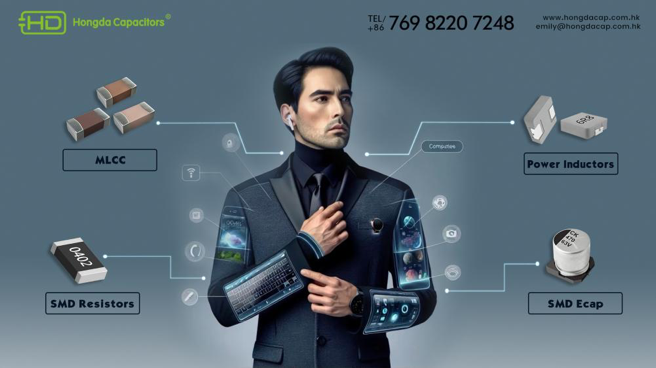
Hongda Capacitors offer Capacitors, inductors, and SMD resistors in small size-01005 / 0201/0402, we support different industrial, specially the ESL, Smart wearable devices, Smartphones / Tablets / Laptops, Smart Home / Wearable Devices, Audio-Visual / Digital Devices, Power Tools with our high quality capacitors & Inductors.
Welcome your RFQ, find me here: emily@hongdacap.com.hk
MP/ Whatsapp:+86 13543726447
You will get best engineering service and best offer from Hongda Capacitors team.


 English
 Chinese Simplified
 Russian
 Vietnamese
 Spanish
 Portuguese
 Arabic
 German
 Korean
 Polish
 Italian
 Turkish
 Belarusian
 Bulgarian
 Croatian
 Czech
Czech
 Danish
 Dutch
Dutch
 Estonian
 Filipino
 Finnish
 French
 Hungarian
 Indonesian
 Irish
Irish
 Japanese
 Lithuanian
 Norwegian
 Romanian
 Serbian
 Slovak
 Slovenian
 Swedish
 Thai
Thai


