Global Passive Component Shortage 2026–2028: How AI Computing Is Reshaping MLCC, Supercapacitor and Resistor Supply
2026-06-29
The passive component market is experiencing significant changes. Demand from AI servers, electric vehicles, and high-performance computing is reshaping the supply chain. Shortages, extended lead times, and price increases are becoming the new normal.
1. Supercapacitors: Shortage Extends to 2028
Supercapacitors, once secondary supporting parts next to aluminum electrolytic capacitors, are now irreplaceable core components for AI server power systems.GPU loads switch to millisecond-level pulse power, and racks running at 600–800kW rely on microsecond-response supercapacitors to fill power peak gaps. Demand surges sharply: each GB300 server rack uses around 300 supercapacitors, while next-gen Rubin racks require nearly 2,000 units. A single product generation brings market demand worth nearly USD 1 billion.
However, global annual effective production capacity of 2nd-generation LIC supercapacitors is only hundreds of thousands of pieces. Even the planned capacity expansion target of 6.5 million units will not be fully realized until late 2026. Industry insiders predict supply and demand will not balance until late 2027 to early 2028.
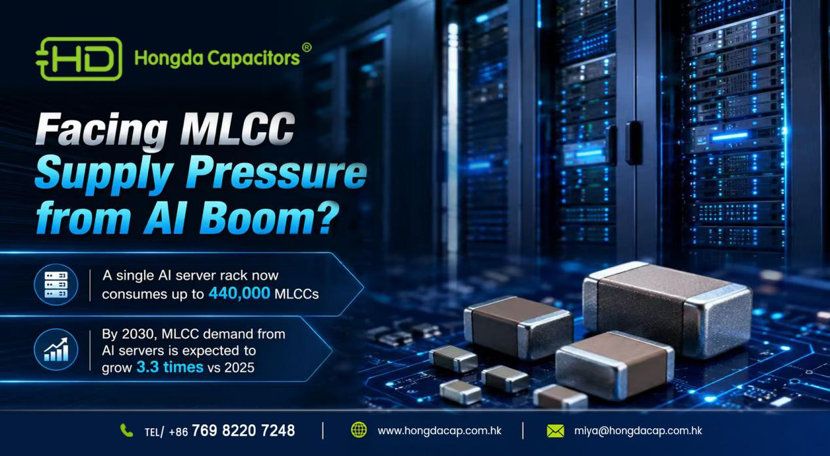
2. MLCC: Widespread Shortage to Last Until 2028, Prices Surge
AI infrastructure has pushed MLCC demand and average prices upward simultaneously, with shortages spreading to all mainstream specifications, not just high-end AI models.Top global brands including Murata and Samsung Electro-Mechanics are shifting most production lines to high-value AI server orders, cutting back mass-volume low-end MLCC supplies for phones, laptops and consumer devices. Key high-capacity models such as 10μF, 22μF and 47μF X5R MLCCs are facing critical stockouts, with lead times stretching to over 20 weeks for many parts.
Industry forecasts confirm this shortage cycle will continue through 2027 and possibly 2028, more severe than the 2018 passive component supply crisis.
3. Chip Resistors: Next Explosion of Demand, Price Hikes Coming June–July
Chip resistors will become the next tight supply segment with stronger price growth potential than MLCCs. Annual global resistor consumption hits 75 billion pieces, far exceeding capacitor volumes. The supply chain is dominated by domestic Chinese manufacturers, creating faster price adjustment cycles.The market expects a new round of price increases this June and July. Even entry-level general resistors, originally priced at only a few US cents, may see 5–6x price hikes as inventory runs dry. Fenghua Advanced Technology already ranks No.1 worldwide in resistor shipment volume last year, running factories at maximum utilization rates.

4. Aluminum Electrolytic Capacitors: Full Price Increase from Nichicon
Leading Japanese aluminum electrolytic maker Nichicon announced company-wide price rises recently. Two core triggers drive this adjustment: overwhelming order volume exceeding existing production capacity, and volatile global geopolitics in the Middle East pushing up raw material costs, which manufacturers cannot fully absorb.
5. Our Recommendations to Customers
• Maintain a reasonable inventory level to mitigate the impact of further price increases.
• We suggest ordering 3–6 months of stock as a buffer.
• Once stock is available, place orders early to lock in current pricing and secure supply.
• Consider alternative sourcing strategies for stable supply.
6. How Hongda Capacitors Supports Customers
1) Comprehensive Passive Component Supply
We supply a wide range of passive components, including MLCC (with semi-finished stock available), chip resistors, inductors, tantalum capacitors, aluminum electrolytic capacitors, and supercapacitors, fully compatible with AI servers, smart meters, consumer devices and more.
2) Alternative Solutions for Well-Known Brands
Our components offer reliable replacements for leading brands including AVX, KEMET, Murata, Samsung Electro-Mechanics, and Nichicon — delivering the same performance with better pricing and faster delivery.
3) Professional Technical Support
We provide free test samples, datasheets, reliability test reports, and customized alternative solutions. Our engineering team can assist with component selection for RF circuits, power backup, pulse-load AI server designs, and various other applications.
FAQ
What is causing the passive component shortage in 2026?
The main drivers are AI server growth, electric vehicle demand, high-performance computing, industrial power electronics and capacity allocation by leading passive component manufacturers.
Which passive components are most affected?
MLCCs, supercapacitors, chip resistors and aluminum electrolytic capacitors are among the most affected categories. High-capacitance MLCCs and fast-response supercapacitors are especially sensitive to AI infrastructure demand.
How long could the passive component shortage last?
Some supply pressure may continue through 2027 and possibly toward 2028, especially for high-end MLCCs, advanced supercapacitors and components used in AI server power systems.
How can buyers reduce procurement risk?
Buyers should prepare 3–6 months of inventory, qualify alternative suppliers, review high-risk part numbers and place orders early when stock is available.
Can Hongda Capacitors provide alternatives to global brands?
Yes. Hongda Capacitors can provide passive component alternatives for major brands and support customers with samples, datasheets, reliability reports and engineering selection advice.
Contact Us
If you are facing supply shortages, extended lead times, or want to discuss your procurement plan, feel free to reach out. We are ready to support you.


 English
 Chinese Simplified
 Russian
 Vietnamese
 Spanish
 Portuguese
 Arabic
 German
 Korean
 Polish
 Italian
 Turkish
 Belarusian
 Bulgarian
 Croatian
 Czech
Czech
 Danish
 Dutch
Dutch
 Estonian
 Filipino
 Finnish
 French
 Hungarian
 Indonesian
 Irish
Irish
 Japanese
 Lithuanian
 Norwegian
 Romanian
 Serbian
 Slovak
 Slovenian
 Swedish
 Thai
Thai


