2026 MLCC Industry Update: AI Demand Drives Supply Pressure in High-Capacitance MLCCs
2026-07-05
The global MLCC market is entering a new supply cycle in 2026. Demand from AI servers, high-performance computing, automotive electronics and AI-enabled consumer devices is increasing pressure on selected high-capacitance MLCC specifications.
The shortage is no longer limited to ultra-high-end AI infrastructure. Some mainstream X5R MLCC models used in consumer electronics, industrial control, PCs and power modules are also facing longer lead times and rising procurement risk.
For buyers, engineers and EMS manufacturers, the most important action is to review high-risk MLCC part numbers early, prepare safety stock and qualify alternative suppliers before production demand becomes urgent.
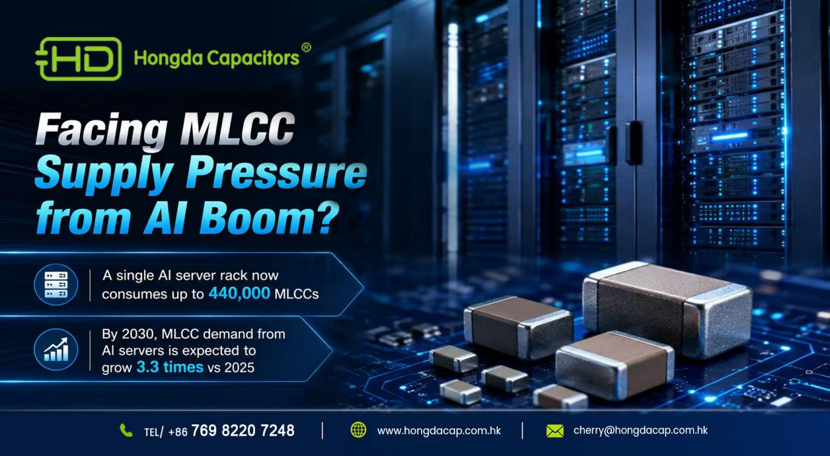
Why the MLCC Market Is Tightening in 2026
Multilayer ceramic capacitors, commonly known as MLCCs, are essential passive components used for decoupling, filtering, voltage stabilization and noise suppression in electronic circuits. As electronic systems become smaller, faster and more power-dense, demand for high-capacitance and high-reliability MLCCs continues to increase.
In 2026, AI infrastructure has become one of the strongest demand drivers. AI servers and accelerators require more stable power delivery, higher current handling and more complex voltage regulation. This increases the consumption of premium MLCCs around GPUs, CPUs, memory modules and power management circuits.
At the same time, automotive electronics, industrial automation, AI PCs, smart devices and edge computing products are also increasing MLCC usage. The result is a more competitive supply environment for high-capacitance MLCC specifications.
Capacity Shift by Leading MLCC Manufacturers
A key reason behind the current supply pressure is capacity prioritization. Leading Japanese and Korean MLCC manufacturers are allocating more production capacity to high-margin applications such as AI servers, automotive electronics, data centers and high-performance computing.
This strategy improves profitability for major suppliers, but it also reduces flexibility for standard commercial and consumer-grade MLCC supply. As premium production lines become increasingly focused on AI and automotive applications, selected mainstream MLCC specifications may experience tighter allocation and longer delivery schedules.
This does not mean every MLCC specification is in shortage. The market is becoming more polarized: high-end and high-capacitance parts are under stronger pressure, while some standard specifications may remain relatively available. However, for buyers using large volumes of 10μF, 22μF and 47μF X5R MLCCs, sourcing risk should be reviewed carefully.
Mainstream MLCC Specifications Under Pressure
The current supply pressure is especially visible in high-capacitance X5R MLCCs used in mobile phones, laptops, PCs, power supplies, AI terminals, industrial modules and automotive electronics.
Commonly affected specifications include:
- 10μF X5R MLCC
- 22μF X5R MLCC
- 47μF X5R MLCC
- High-capacitance MLCCs used in power management circuits
- MLCCs used for AI server boards, GPU modules and advanced computing systems
For electronic manufacturers, the risk is not only price increase. Longer lead times can also delay production planning, increase inventory pressure and create uncertainty in BOM cost control.
Why Capacity Expansion Cannot Solve the Problem Immediately
Although several MLCC manufacturers are expanding production, new capacity cannot be released overnight. MLCC production requires specialized equipment, process control, ceramic material preparation, electrode printing, stacking, sintering, testing and strict quality verification.
High-end MLCC production equipment also has long delivery and commissioning cycles. Even when suppliers announce expansion plans, new production capacity may take several quarters or longer before it can meaningfully support market demand.
This means buyers should not rely only on future capacity expansion. For high-risk MLCC part numbers, early purchasing, second-source qualification and long-term supply planning remain necessary.
Procurement Risks for Consumer Electronics and Industrial Buyers
Consumer electronics manufacturers are especially sensitive to MLCC supply changes because they often use large quantities of standardized components. When high-volume specifications become tight, even small price changes can affect total BOM cost.
Industrial control, power supply, smart meter, security device, automotive electronics and AI terminal projects also face similar risks. These applications require stable quality, consistent delivery and reliable long-term availability.
Procurement teams should pay attention to the following risk signals:
- Lead times extending beyond normal delivery cycles
- Sudden price adjustments from original suppliers
- Limited allocation for high-capacitance MLCCs
- Difficulty securing 10μF, 22μF or 47μF X5R parts
- BOM dependency on a single Japanese or Korean brand
- Lack of approved alternative components
How Buyers Can Reduce MLCC Supply Chain Risk
To reduce production risk during the 2026 MLCC supply cycle, Hongda Capacitors recommends the following actions:
- Review all high-capacitance MLCC part numbers in current BOMs.
- Identify 10μF, 22μF and 47μF X5R models with high monthly consumption.
- Prepare 3 to 6 months of safety stock for critical projects.
- Qualify alternative MLCC suppliers before shortages become urgent.
- Compare voltage, capacitance, tolerance, temperature characteristics, package size and reliability requirements.
- Confirm whether equivalent or semi-finished stock can support urgent production.
- Lock in price and delivery schedules when qualified stock is available.
How Hongda Capacitors Supports Stable MLCC Supply
Hongda Capacitors provides reliable passive component sourcing support for customers facing MLCC shortages, long lead times or cost pressure.
We supply a wide range of passive components, including MLCCs, aluminum electrolytic capacitors, tantalum capacitors, supercapacitors, polymer capacitors, chip resistors and inductors.
For mainstream tight-spec MLCC models, Hongda Capacitors maintains strategic inventory and flexible sourcing support for common high-capacitance X5R series, including 10μF, 22μF and 47μF models.
Our advantages include:
- Fast shipment for selected MLCC models
- Stable quality and mature production process
- Support for BOM matching and alternative selection
- Flexible price-lock and delivery planning
- Technical support for consumer electronics, industrial control, AI terminals and automotive electronics
- Samples, datasheets and reliability test support
By working with Hongda Capacitors, customers can reduce procurement uncertainty, avoid production delays and build a more resilient passive component supply chain.

Send Us Your MLCC BOM
If you are facing long lead times, price increases or urgent demand for MLCCs, send your BOM, specifications and estimated quantity to Hongda Capacitors.
Our team can help check stock availability, recommend suitable alternatives and provide a competitive quotation for your project.
Contact Hongda Capacitors today to secure stable MLCC supply for your 2026 production plan.


 English
 Chinese Simplified
 Russian
 Vietnamese
 Spanish
 Portuguese
 Arabic
 German
 Korean
 Polish
 Italian
 Turkish
 Belarusian
 Bulgarian
 Croatian
 Czech
Czech
 Danish
 Dutch
Dutch
 Estonian
 Filipino
 Finnish
 French
 Hungarian
 Indonesian
 Irish
Irish
 Japanese
 Lithuanian
 Norwegian
 Romanian
 Serbian
 Slovak
 Slovenian
 Swedish
 Thai
Thai


