2026 MLCC situation vs 2018 Cycle,and Market Watch
2026-09-22
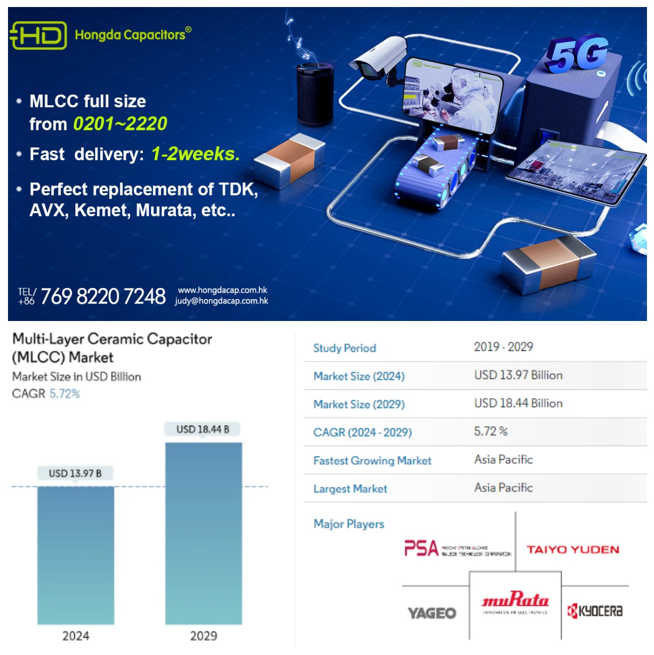
The 2026 MLCC market is tight again, but the setup looks different from 2018. This time it's not a broad consumer-electronics shortage — it's a structural squeeze on high-end parts driven by AI server demand. A few things worth tracking: the production and pricing moves at Samsung Electro-Mechanics, Murata, and Yageo, and Hongda Capacitors's differentiation on lead time and inventory strategy. Below is a side-by-side of the two cycles, what the top three vendors are doing right now, and where Hongda Capacitors's MLCC and HSLC lines fit.
1. 2026 vs. 2018: Two Shortages Compared
The 2018 MLCC shortage was driven mainly by Japanese vendors cutting legacy mid/low-end capacity, on top of demand from consumer electronics and early-stage automotive electrification. Murata shifted general-purpose capacity toward automotive and industrial lines, prices went up across the board, and the consumer electronics supply chain was broadly hit — the entire industry went into a stock-build mode.
The 2026 cycle is different. Incremental demand comes mainly from large-scale AI compute hardware rollouts. High-capacitance, high-frequency, and high-reliability parts are tight; ordinary consumer-grade is actually fine on supply. Vendors are also acting earlier on product mix — legacy low-margin series are being phased out ahead of schedule. The high-end gap is therefore more persistent and more predictable than the 2018 cycle.
2. Top Vendor Updates
2026 is a year of tight moves from the top three, with pricing and supply actions feeding directly into global procurement.
Samsung Electro-Mechanics: September Re-Pricing + NVIDIA Locks Three-Year Capacity
NVIDIA has also locked three years of exclusive AI-grade MLCC capacity from Samsung. That capacity is taken out of circulation for other industrial and commercial customers, which extends the high-end shortage window.
Samsung Electro-Mechanics is the most direct beneficiary of the AI shortage this round. In September 2026, the company announced a roughly RMB 5.2 billion long-term MLCC contract for AI applications, covering high-spec, high-stability parts going into core AI server circuits. The order locks Samsung's position in the global high-end AI passive component market.
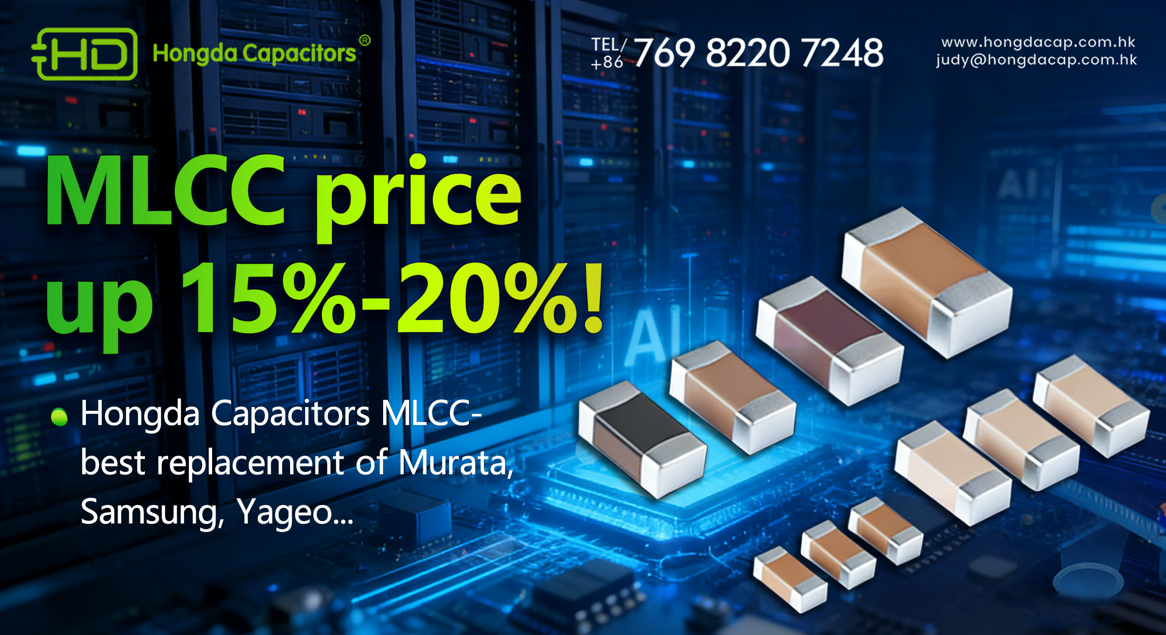
Samsung put through another MLCC price hike in September, after a broad adjustment in August. Consumer-grade is up 25%–30%; AI-specific high-capacitance parts are up 10%–20%.
Murata: Large-Scale EOL, Faster Shift to High-End
Murata is continuing its production and product restructuring. In 2026 the company is running a broad EOL program across multiple legacy mid/low-end general-purpose series, freeing capacity for automotive, industrial, and AI server MLCCs.
This EOL wave has created a visible gap in the mid/low-end market, forcing global OEMs and EMS manufacturers to accelerate second-source qualification and re-certification. Murata's automotive and AI MLCC lead times are already past 20 weeks, and the tightness is expected to continue through H1 2027.
Yageo: Main Alternative Under Segmented Lead-Time Pressure
Driven by Samsung's and Murata's witHongda Capacitorsrawal from mid/low-end and the EOL concentration, Yageo — the third-largest MLCC supplier globally — has picked up a large volume of transferred orders and run high utilization through 2026. Lead times are clearly segmented: standard small-size general parts hold at 2–6 weeks; mid/high-capacitance consumer parts stretch to 8–16 weeks; high-reliability automotive and industrial parts are tight at 16–28 weeks. With stable mass production, Yageo is the most reliable transitional source for mid-range MLCC demand.
3. Hongda Capacitors MLCC: Differentiation in Lead Time and Inventory
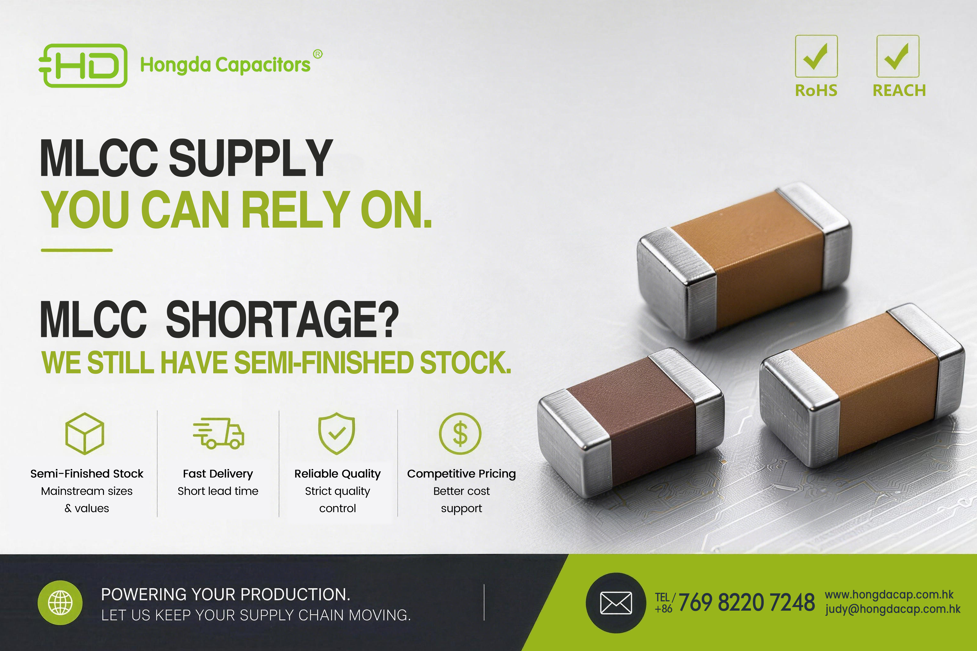
Against the backdrop of industry-wide long lead times and unstable supply, Hongda Capacitors MLCC differs on delivery efficiency and supply mechanism. Most mainstream parts can ship in 2–4 weeks, which directly addresses the long-wait pain point for AI, communications, and industrial customers.
Hongda Capacitors uses a semi-finished inventory strategy — stocking large quantities of semi-finished components in advance, then quickly completing final packaging and testing against customer orders. This shortens production cycles and avoids shortage risk, giving a relatively stable supply for high-frequency and high-reliability scenarios.
4. Hongda Capacitors Hongda HSLC (Single-Layer Capacitor) Specs and Applications
Targeted at high-end RF, aerospace, and military demand in 5G/6G communications, satellite, and radar, Hongda Capacitors is launching the Hongda HSLC single-layer capacitor series, with full spec coverage and drop-in replacement for international mainstream brands.
Core Features and Packaging
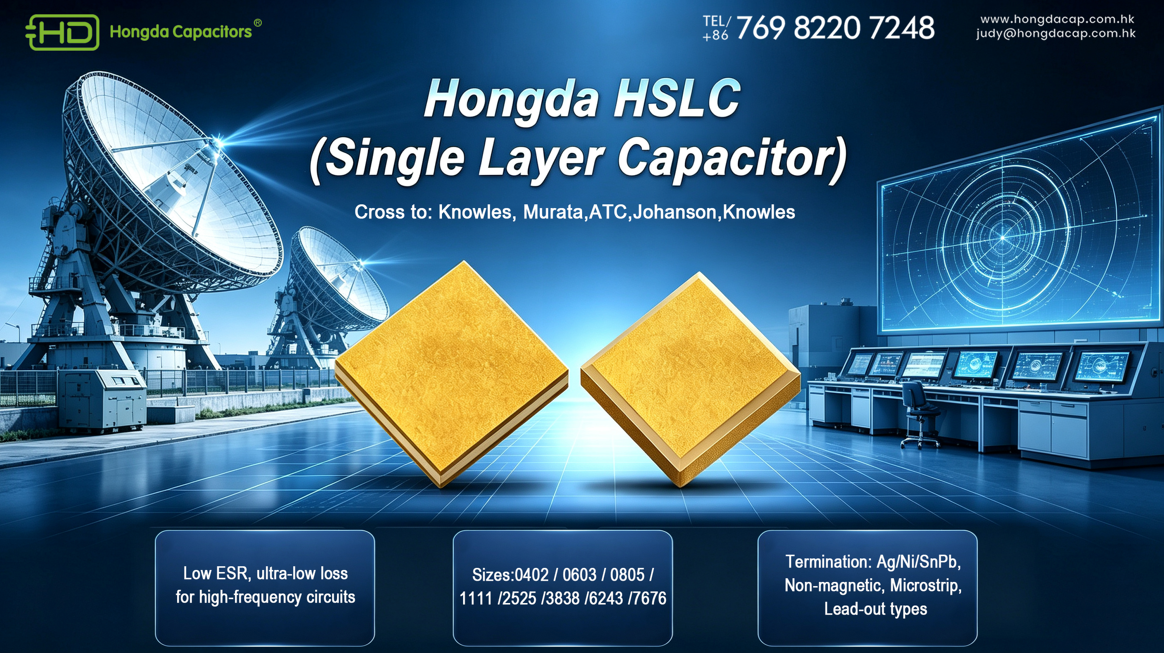
HSLC uses Ag/Ni/SnPb multi-layer termination, supports non-magnetic design, and fits high-precision RF signal transmission scenarios sensitive to magnetic interference. Packaging includes microstrip and leaded types to cover different installation requirements.
Electrical Performance
Hongda Capacitors HSLC capacitors feature low ESR and ultra-low loss, delivering stable and efficient performance in high-frequency circuits. They reduce signal attenuation and heat loss, meeting the performance requirements of high-end communications and radar systems.
Size Coverage
The series covers all mainstream industry sizes: 0402 / 0603 / 0805 / 1111 / 2525 / 3838 / 6243 / 7676, from miniature consumer RF modules up to large high-power industrial equipment.
Standards and Cross-Compatibility
The series complies with the GJB-2442A-2021 military standard, ensuring high reliability, stability, and durability in extreme environments. It cross-references with Knowles, Murata, ATC, and Johanson international brands, giving customers a cost-controlled, supply-stable alternative.
Typical Applications
Hongda Capacitors HSLC single-layer capacitors are widely used in satellite payloads, radar T/R units, and 5G-6G RF modules — a common high-reliability passive component choice for aerospace, military, and next-generation communications infrastructure.
From late 2026 through H1 2027, the AI-driven structural MLCC shortage will continue. Samsung's capacity is locked by long-term AI orders; Murata's ongoing EOL keeps mid-range supply tight; Yageo's high-grade lead times persist. In this context, Hongda Capacitors's MLCC and HSLC lines — fast delivery and on-spec — can fill the supply gap for high-frequency and high-reliability applications, giving downstream manufacturers a stable, efficient, cost-controlled component option as the supply chain rebalances.
welcome to know more details at judy@hongdacap.com.hk, thanks.


 English
 Chinese Simplified
 Russian
 Vietnamese
 Spanish
 Portuguese
 Arabic
 German
 Korean
 Polish
 Italian
 Turkish
 Belarusian
 Bulgarian
 Croatian
 Czech
Czech
 Danish
 Dutch
Dutch
 Estonian
 Filipino
 Finnish
 French
 Hungarian
 Indonesian
 Irish
Irish
 Japanese
 Lithuanian
 Norwegian
 Romanian
 Serbian
 Slovak
 Slovenian
 Swedish
 Thai
Thai


