Capacitors for Drones & UAVs: 4 Failure Modes and How to Choose the Right Capacitor
2026-10-08
Why Capacitor Selection Matters in Drone and UAV Electronics
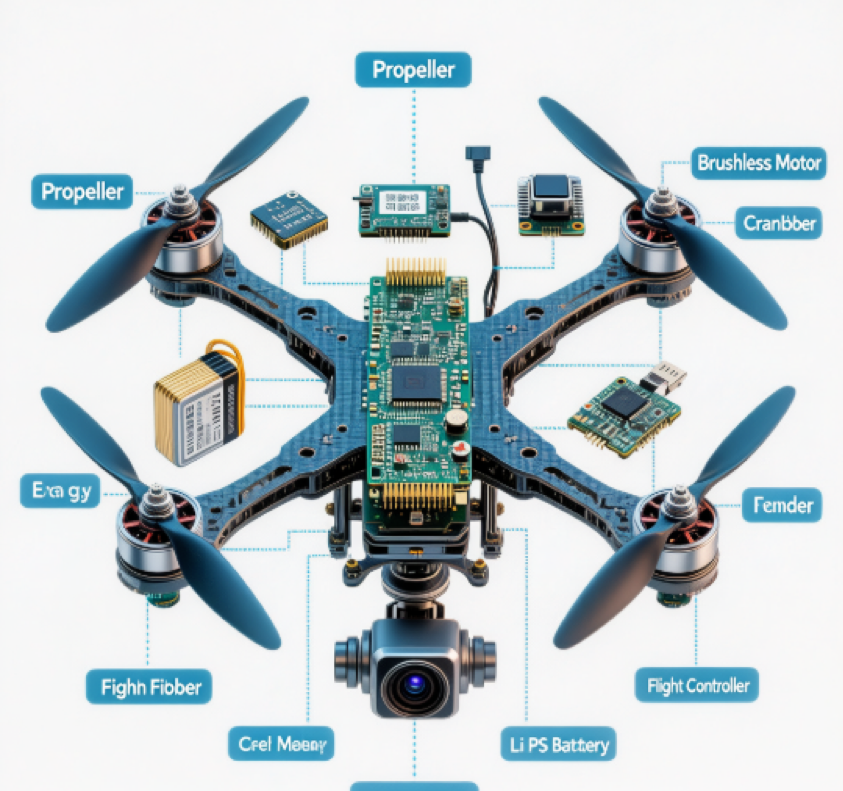
An industrial UAV combines several electrically demanding systems in a compact, lightweight platform. A typical aircraft may contain flight-control computers, electronic speed controllers, DC-DC converters, cameras and gimbals, radar altimeters, RF communication links, navigation sensors and mission payload electronics.
Each subsystem places a different demand on its capacitors. A component that performs well in a general industrial power supply may not necessarily be suitable for a UAV exposed to vibration, rapid load changes, low temperature, high altitude or sensitive RF circuitry.
For this reason, capacitor selection should be based on the actual electrical and environmental stress at each location in the aircraft.
1. Bulk Capacitance on UAV Power Rails
Many industrial UAV platforms use a high-voltage battery bus followed by distributed DC-DC converters that generate lower-voltage rails for flight-control, payload and communication electronics. Those converters require bulk capacitance to help stabilize the rail during load changes.
Important parameters include:
- Rated voltage
- Capacitance
- Ripple-current capability
- ESR
- Temperature range
- Mechanical robustness
- Expected service life
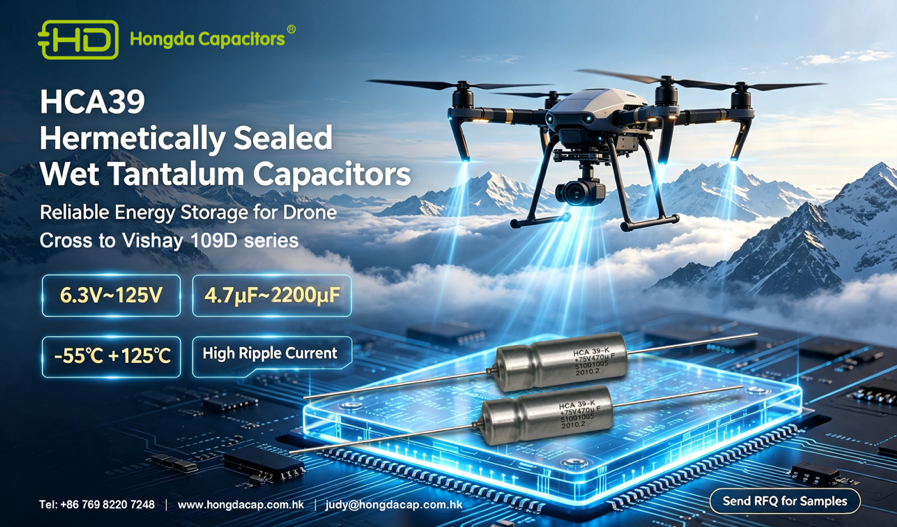
The Hongda HCA39 hermetically sealed tantalum capacitor is one option for this type of duty. The HCA39 range covers 6.3V to 125V, 4.7μF to 2200μF and an operating-temperature range of -55°C to +125°C.
Why Hermetic Construction Can Matter
For high-reliability UAV applications, a hermetically sealed metal case can help protect the capacitor from environmental exposure and support operation through repeated temperature cycling.
This may be particularly useful in platforms that move between:
- Cold high-altitude operation
- Warm ground environments
- Humid storage conditions
- Repeated flight cycles
However, package construction is only one part of qualification. Engineers should still verify the required vibration, shock, temperature and lifetime performance against the applicable datasheet and mission profile.
HCA39 Typical Position in a UAV
- DC-DC converter input filtering
- Flight-control power rails
- Payload power modules
- Gimbal electronics
- Auxiliary power circuits
2. Motor Drives and ESC Ripple Current
Electronic speed controllers are among the most electrically stressful locations in a multirotor UAV. Motor drives draw pulsed current from the DC bus, and inverter-side capacitors must absorb ripple current continuously.
This creates a simple but important thermal relationship: higher ESR produces more internal heating, and higher temperature can accelerate capacitor aging.
For compact ESC and electric propulsion systems, engineers should therefore pay particular attention to:
- ESR
- Ripple-current rating
- Capacitance
- Working voltage
- Temperature capability
- Package volume
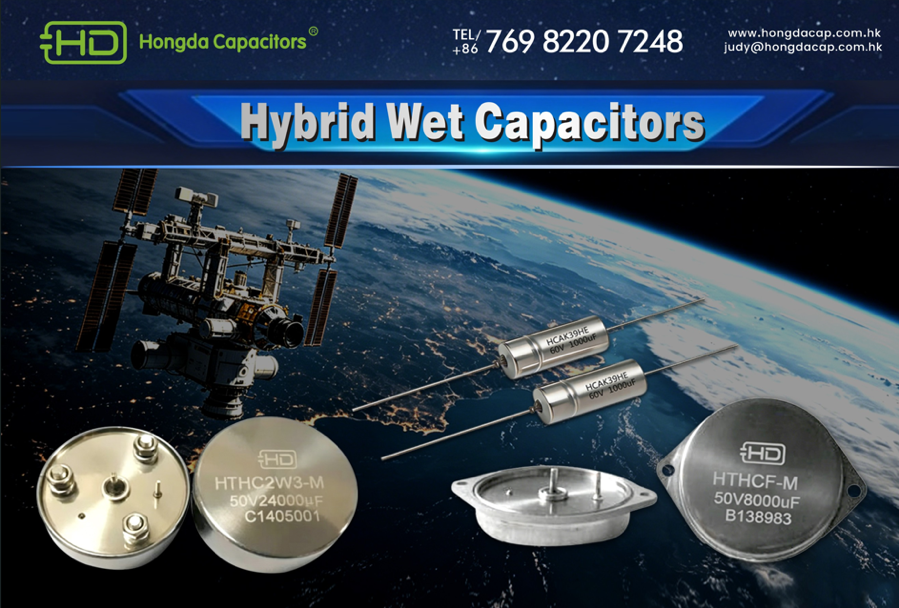
Hongda HTHC2 Hybrid Tantalum for High-Current Power Electronics
The Hongda HTHC2 hybrid tantalum series is specified with:
- ESR: 0.025Ω to 0.1Ω
- Capacitance: 1,100μF to 150,000μF
- Voltage: 10V to 125V
- Storage temperature: -62°C to +130°C
Its high capacitance density can be useful where PCB area or enclosure volume is restricted.
|
Hongda Model
|
Existing Part Reference
|
|
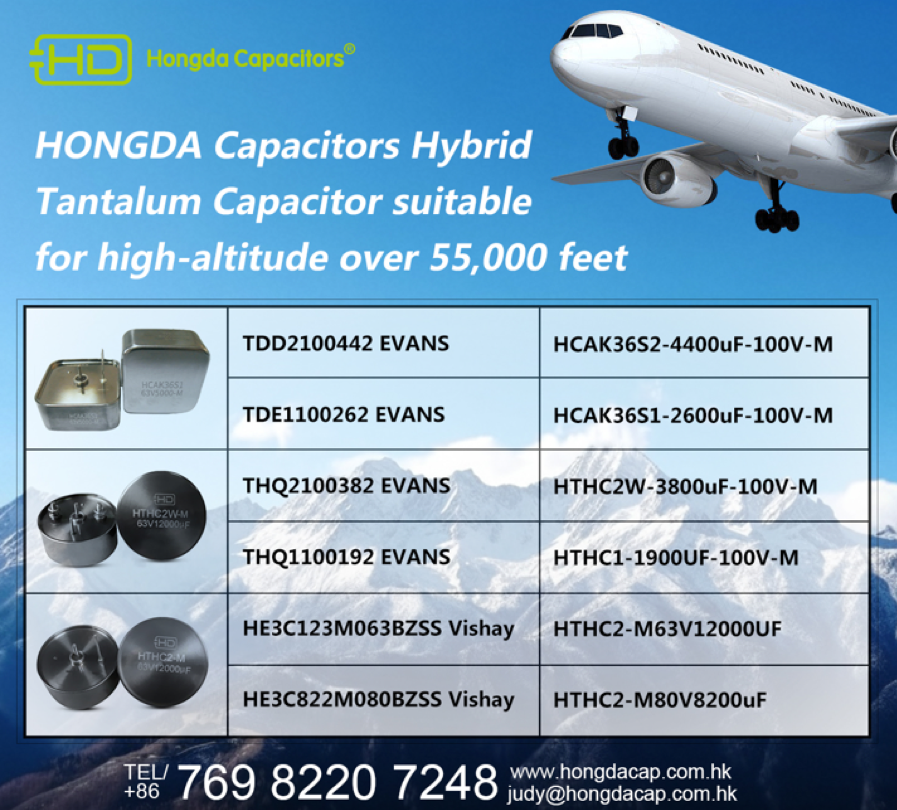
HTHC2-M63V12000UF
|
Vishay HE3C123M063BZSS
|
|
HTHC2-M80V8200UF
|
Vishay HE3C822M080BZSS
|
The HTHC2 family is also positioned against parts from the Evans THQ3, TDD and TDE families. These should be treated as cross-reference candidates for engineering qualification, rather than assumed direct replacements without comparison of the complete specifications.
3. RF Payloads Need a Different Kind of Capacitor
A modern industrial UAV is also a flying communications platform. Depending on the mission, the aircraft may carry:
- Radar altimeters
- Synthetic-aperture radar
- Telemetry radios
- Command-and-control links
- Satellite communication modules
- 5G-connected inspection equipment
- RF sensing payloads
In these systems, capacitor requirements differ substantially from bulk power applications. The designer is usually more concerned with RF losses, parasitic inductance, self-resonant behavior, package geometry, termination material and frequency stability.
Hongda HSLC Single-Layer Capacitors for RF Applications
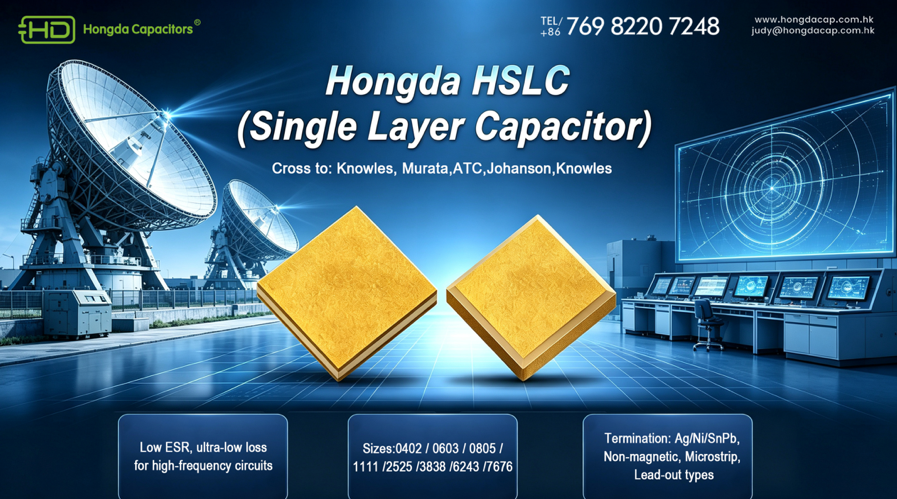
The Hongda HSLC single-layer capacitor line is positioned for RF and microwave applications.
Available package sizes include:
- 0402
- 0603
- 0805
- 1111
- 2525
- 3838
- 6243
- 7676
Termination options include:
- Ag/Ni/SnPb
- Non-magnetic
- Microstrip
- Lead-out versions
Typical applications include radar T/R modules, satellite payloads and 5G/6G RF circuits.
Why Non-Magnetic Terminations Matter
UAVs often carry magnetometers as part of their navigation and attitude-sensing system. Where capacitors are located close to magnetic sensors, engineers may need to evaluate whether ferromagnetic termination materials could influence sensor accuracy. For those applications, a non-magnetic capacitor option may be appropriate.
4. High Altitude Changes the Reliability Problem
High-altitude UAVs introduce another environmental factor: low atmospheric pressure. Platforms operating above approximately 55,000 feet may require additional attention to package integrity and electrical stability.
For these missions, designers should evaluate:
- Leakage current
- Package integrity
- Seal quality
- Electrical stability
- Temperature cycling
- Low-pressure qualification
Hongda's hybrid tantalum range is described as being qualified for operation above 55,000 feet, with electrical performance, DCL and package integrity evaluated under low-pressure conditions.
This is especially relevant for:
- HALE UAVs
- Upper-atmosphere research platforms
- Aerospace test vehicles
- High-altitude communication platforms
- Specialized defense UAVs
Four UAV Capacitor Problems at a Glance
|
UAV Location
|
Main Risk
|
Important Capacitor Characteristics
|
Hongda Product Family
|
|
DC power rail
|
Brownout / unstable voltage
|
Bulk capacitance, temperature, reliability
|
HCA39
|
|
ESC / motor drive
|
Ripple-current heating
|
Low ESR, high capacitance, ripple capability
|
HTHC2
|
|
RF / radar payload
|
Signal loss / parasitics
|
Low loss, RF behavior, termination options
|
HSLC
|
|
High-altitude electronics
|
Low-pressure reliability
|
Package integrity, leakage stability
|
Hybrid tantalum range
|
Standards and Screening for High-Reliability UAV Capacitors
Hongda's hybrid capacitor range is produced to GJB733A-96 and QJ/PWV319-2010 requirements.
|
Screening Level
|
General Positioning
|
|
Military level
|
Standard military screening
|
|
GJB level
|
Chinese national military standard
|
|
Seven Special
|
Tighter screening and controls
|
|
Seven Special Plus
|
Further tightened requirements
|
|
Aerospace
|
Aerospace-grade screening
|
The practical point is that the screening level should match the mission. A commercial inspection drone and a high-altitude or defense platform do not necessarily require the same component screening. Over-specification can increase cost, while under-specification can introduce unacceptable reliability risk.
How to Specify Capacitors for a Drone or UAV
For Power-Rail Capacitors
- Maximum working voltage
- Derating requirements
- Capacitance
- Ripple current
- ESR
- Temperature
- Package size
- Vibration and shock
For ESC and Motor-Drive Capacitors
- Peak and RMS ripple current
- ESR at operating frequency
- Internal temperature rise
- Required capacitance
- Switching frequency
- Mission duty cycle
For RF Capacitors
- Working frequency
- Loss characteristics
- Self-resonant frequency
- Termination
- Package size
- Magnetic-material restrictions
For High-Altitude Applications
- Pressure qualification
- Leakage-current stability
- Package integrity
- Thermal cycling
- Required screening level
Cross-Reference Support for Existing UAV Designs
Many UAV programs already have qualified Western-brand components on the BOM. Hongda cross-reference coverage includes brands and families such as:
- Vishay 109D
- Vishay HE3
- Evans THQ3
- Evans TDD
- Evans TDE
- Knowles
- Murata
- ATC
- Johanson
For an existing design, the safest process is:
- Provide the existing manufacturer and part number.
- Provide the original datasheet.
- Identify the circuit position.
- Confirm voltage, capacitance and ESR requirements.
- Define environmental and screening requirements.
- Compare mechanical dimensions and mounting.
- Evaluate samples before production qualification.
This produces a much more reliable cross-reference than selecting a replacement solely from capacitance and voltage.
Frequently Asked Questions About Capacitors for Drones
What capacitors are used in drones?
Drones can use several capacitor technologies depending on the circuit. Bulk power rails may use tantalum or other high-capacitance devices, ESCs require capacitors capable of handling ripple current, and RF payloads may use single-layer ceramic capacitors optimized for high-frequency performance.
Why is low ESR important in a drone ESC?
Ripple current flowing through ESR produces heat. In high-current motor-drive circuits, excessive ESR can therefore increase capacitor temperature and reduce long-term reliability.
What capacitor characteristics matter for high-altitude UAVs?
Engineers should evaluate low-pressure performance, leakage current, package integrity, temperature range and the relevant screening or qualification requirements.
Why are hermetically sealed capacitors used in UAVs?
Hermetic packages can provide additional environmental protection for applications exposed to severe temperature cycling and demanding reliability requirements.
What type of capacitor is suitable for UAV radar and RF payloads?
High-frequency circuits may require low-loss ceramic capacitors with appropriate package sizes and termination materials. Hongda's HSLC single-layer capacitor range is positioned for radar, satellite and RF applications.
Can Hongda provide replacements for Vishay, Evans, Knowles or Murata capacitors?
Hongda provides cross-reference evaluation for multiple international capacitor families. Final approval should be based on electrical, mechanical and environmental qualification for the specific UAV application.
How should capacitor screening level be selected?
The screening requirement should match the mission profile. Commercial UAVs, high-altitude platforms and defense systems may have very different reliability and qualification requirements.
Need Capacitor Support for a UAV or Drone Project?
If you are designing a new UAV power, ESC, RF or high-altitude system—or need an alternative to an existing capacitor—send Hongda Capacitors:
- Current manufacturer
- Part number
- Datasheet
- Application
- Voltage and capacitance
- ESR / ripple requirement
- Operating temperature
- Altitude requirement
- Expected annual quantity
Hongda can review the requirement and recommend a suitable HCA39, HTHC2, HSLC or other capacitor candidate for engineering qualification.


 English
 Chinese Simplified
 Russian
 Vietnamese
 Spanish
 Portuguese
 Arabic
 German
 Korean
 Polish
 Italian
 Turkish
 Belarusian
 Bulgarian
 Croatian
 Czech
Czech
 Danish
 Dutch
Dutch
 Estonian
 Filipino
 Finnish
 French
 Hungarian
 Indonesian
 Irish
Irish
 Japanese
 Lithuanian
 Norwegian
 Romanian
 Serbian
 Slovak
 Slovenian
 Swedish
 Thai
Thai


